

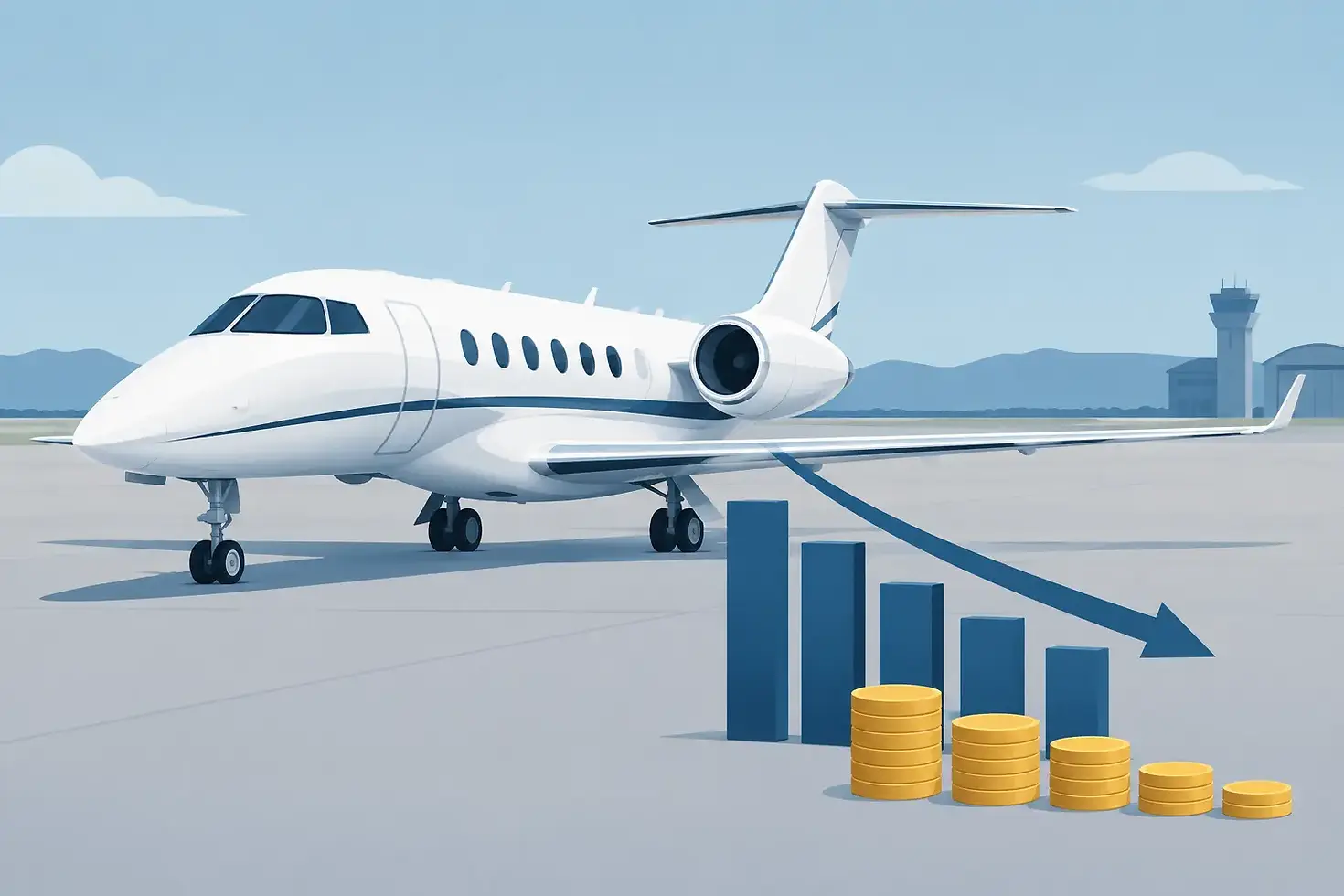
Aircraft Depreciation Explained for Owners
The acquisition price is only the opening number in an aircraft ownership decision. From the moment title transfers, aircraft depreciation explained properly becomes a question of asset strategy: how quickly value may change, what protects it, how tax treatment differs from market reality, and when an owner should act. For a private aircraft owner or flight department, depreciation is not simply an accounting entry. It directly affects capital planning, financing, resale options, and the true cost of access to aviation.
What Aircraft Depreciation Actually Measures
At its most basic, depreciation is the reduction in an aircraft's value over time. Yet there is no single depreciation figure that tells the whole story. An aircraft can have a book value, a tax basis, an insured value, and a market value at the same time. Each serves a different purpose, and confusing them can create expensive assumptions.
Market depreciation is what most owners mean when they ask what an aircraft is worth. It is the difference between its acquisition cost and the price a qualified buyer is likely to pay in the current market. That value responds to supply, demand, maintenance status, aircraft age, cabin condition, avionics, engine program coverage, and the availability of comparable aircraft.
Book depreciation is an accounting treatment that allocates an asset's cost over a defined useful life. It helps a company present financial results consistently, but it does not determine what the aircraft will sell for. Tax depreciation, meanwhile, follows rules established for eligible business assets and may accelerate deductions in certain circumstances. It can improve after-tax cash flow, but it does not stop the market from repricing the aircraft.
Market Value Is the Number That Governs Exit Strategy
An owner may claim meaningful tax depreciation while the aircraft retains value unusually well in a strong market. The opposite can also occur. A model can lose market value faster than expected during an economic slowdown, after a new aircraft program enters service, or when an aging fleet faces costly compliance requirements.
This is why a purchase model should include a projected resale range rather than a single residual-value assumption. The right question is not, “How much will this aircraft depreciate?” It is, “What are the credible value outcomes at the planned point of sale, and what operational choices influence them?”
Why Aircraft Depreciation Is Not a Straight Line
Cars often follow predictable age-based value curves. Aircraft do not. A five-year-old aircraft with low utilization, current maintenance, a desirable cabin, and complete records may command a premium over a comparable aircraft with deferred inspections or an undesirable equipment configuration. In private aviation, condition and marketability can outweigh calendar age.
Maintenance Status Can Move the Value Equation
Major maintenance events are among the clearest value drivers. Engine overhauls, hot-section inspections, landing gear work, structural inspections, paint, interior refurbishment, and avionics upgrades all affect what a buyer must spend after closing. An aircraft approaching several expensive events may be priced at a discount, while an aircraft fresh from those events may attract stronger interest.
That does not mean every dollar spent on maintenance returns as sale value. Routine maintenance primarily preserves airworthiness and market access. Cosmetic and cabin investments may strengthen buyer appeal, but their recovery depends on taste, aircraft class, and timing. The disciplined approach is to distinguish between required maintenance, value-protecting maintenance, and elective improvements that support the ownership experience more than resale proceeds.
Utilization Matters, but So Does How the Aircraft Was Operated
Higher flight hours and cycles generally accelerate wear, particularly for engines and components with life-limited parts. For many aircraft, utilization is a central factor in depreciation analysis. A high-cycle regional or business aircraft can face a different value profile than a lightly used long-range jet, even at the same age.
However, low time is not an automatic advantage. An aircraft that sits for extended periods may develop maintenance issues, fall behind on inspections, or carry records gaps that concern buyers and lenders. Consistent use, disciplined maintenance, and well-documented operational oversight often support value more effectively than low hours alone.
Market Cycles and Model Popularity Set the Baseline
Aviation markets are cyclical. Availability, interest rates, manufacturer delivery positions, geopolitical events, and corporate travel demand can alter values quickly. Aircraft in high demand with constrained supply may hold value exceptionally well. Models with a large inventory overhang, an approaching replacement program, or limited global support may depreciate faster than their technical capability would suggest.
Cabin configuration also matters. Connectivity, seating layout, galley capability, baggage access, lavatory configuration, and range can determine whether an aircraft appeals to the next buyer. An aircraft should be configured for its mission, but a highly customized layout can narrow the resale market. The strongest ownership decisions balance tailored utility with broad future marketability.
Aircraft Depreciation Explained Through Tax Planning
Tax depreciation can be valuable, but it should never be treated as a substitute for a sound acquisition decision. Under US tax rules, certain aircraft used predominantly for qualified business purposes may be eligible for accelerated depreciation methods, subject to current law, substantiation requirements, and the owner's specific tax position. The details matter.
Business-use percentage, passenger documentation, related-party use, entertainment restrictions, leasing structures, and state tax considerations can all affect the result. Personal use can limit deductions. If an aircraft is sold for more than its adjusted tax basis, depreciation recapture may also create taxable income. A strong initial deduction can therefore shift tax liability rather than eliminate it.
For that reason, tax counsel, aviation counsel, and the owner's financial team should evaluate the operating structure before the transaction closes. The acquisition entity, management arrangement, charter activity, and intended use must align with the operational facts. The best tax outcome is one that remains defensible after detailed review, not one built on optimistic assumptions.
Managing Depreciation Begins Before Acquisition
The most effective way to manage depreciation is to buy the right aircraft at the right basis. That requires more than selecting a make and model. It means evaluating the specific serial number, maintenance forecast, damage history, logbook completeness, engine and APU status, enrolled programs, equipment, and market comparables.
A lower purchase price can be attractive, but it may conceal a substantial capital event. Conversely, an aircraft priced above market may be justified if it has recently completed major inspections, includes transferable programs, or requires no immediate modernization. The decision should be based on total ownership cost over the intended hold period, not the headline price alone.
A professional pre-purchase evaluation is particularly important because records and technical status influence buyer confidence at resale. Correcting documentation deficiencies years later is difficult and expensive. From day one, owners should preserve clean records, maintain consistent tracking of maintenance and component status, and avoid deferring work that will become a negotiating issue during a future sale.
A Practical Depreciation Scenario
Consider two comparable midsize jets purchased for similar prices. The first has upcoming engine events, an aging cabin, limited connectivity, and incomplete maintenance records. The second has current inspections, enrolled engine coverage, an upgraded cabin, and a well-managed digital maintenance history.
The first aircraft may appear to offer a lower entry cost, but its owner is likely to face earlier capital requirements and greater resale friction. The second may cost more at acquisition, yet its predictable maintenance position and stronger buyer appeal can reduce downside risk. Neither outcome is guaranteed, and the premium must be tested against real market evidence. Still, this is why sophisticated buyers assess depreciation alongside maintenance exposure rather than as a separate financial line item.
Turn Depreciation Into an Ownership Control System
Depreciation should be monitored throughout the ownership cycle, not calculated once during a purchase proposal. Quarterly or semiannual reviews can compare actual utilization, maintenance spending, market inventory, and projected resale value against the original plan. When a market window opens, an owner may decide to sell earlier. When a major inspection approaches, the better decision may be to complete the work and reposition the aircraft for sale with a clean maintenance story.
This level of oversight is where a managed aviation strategy creates measurable value. Fligent combines operational intelligence with asset-focused advisory so owners can evaluate technical, financial, and market signals together rather than through disconnected vendors and reports. The objective is not to eliminate depreciation, which no advisor can promise. It is to make each decision with a clearer view of risk, timing, and value preservation.
An aircraft should support the mission first. But when acquisition discipline, maintenance planning, tax structure, and market intelligence are aligned, depreciation becomes a controlled part of ownership rather than an unpleasant surprise at the point of sale.


Comments